‘Static Bloom’ by J SHIELDS & Dragos Musat
Opening Late Night Art: 2 October (6—9pm).
Continues 3—9 October (12—3pm daily).
Vault Gallery | Project Space, Marlborough House
28–32 Victoria St. BT1 3GG

L'œil sollicité seul rend l'oreille impatiente,
l'oreille sollicitée seule rend l'œil impatient [1]
Robert Bresson
Static Bloom is an exhibition but also an experience, a collaborative artwork, a live performance, an immersive environment, a durational piece, and more. It is hard to pin down –and indeed gains little from being pinned down. First shown at Vault Artist Studios from 2–9 October 2025, with a live performance on the opening evening, the work is a collaboration between ambient producer and experimental vocalist J SHEILDS, and visual artist Dragos Mușat.
Both artists combine digital and traditional media and this is not their first occasion to work together. Early in 2025, Dragos invited James (the J is for James) to provide a soundscape, or as James says ‘to quietly complement’, Longitude of Longing, an exploration of memory, place, and the echoes of past dwellings. For that show, Mușat digitally recreated past homes – including houses, apartment blocks and various dwellings across several countries – scattering them about a fictive digital landscape that users could navigate using a game controller and TV set. Considering the piece as a whole, James’ approach, he felt, was to ‘build an atmosphere of liminal music’ to match the ‘cinematic artwork’. The piece was a success: the pair found that they gelled and discussed opportunities to ‘scale things up’. It was a step towards what has become ‘Static Bloom’, in which they have not only made things bigger and more immersive, but also deepened and enriched the collaborative aspects of this partnership.
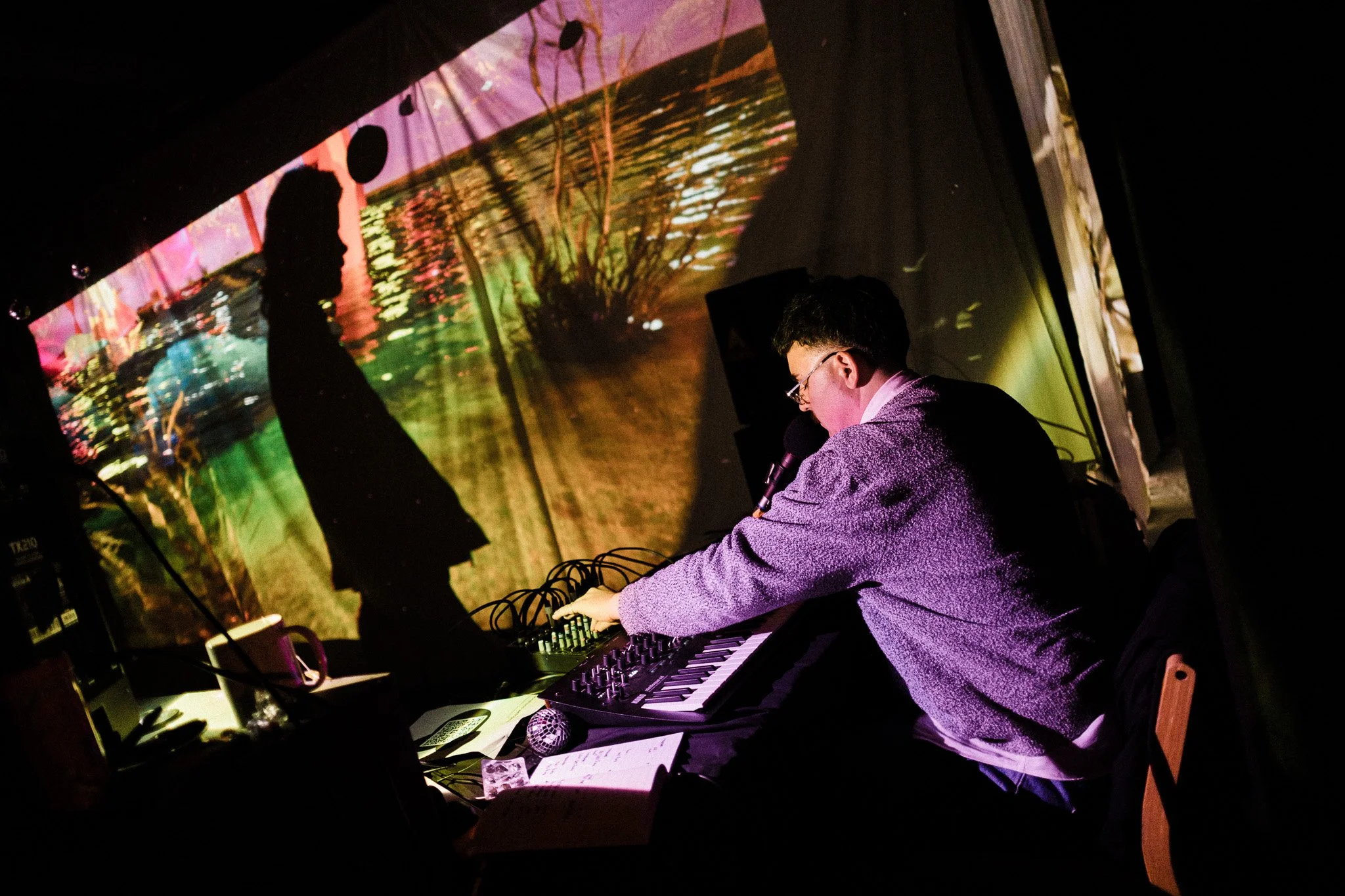
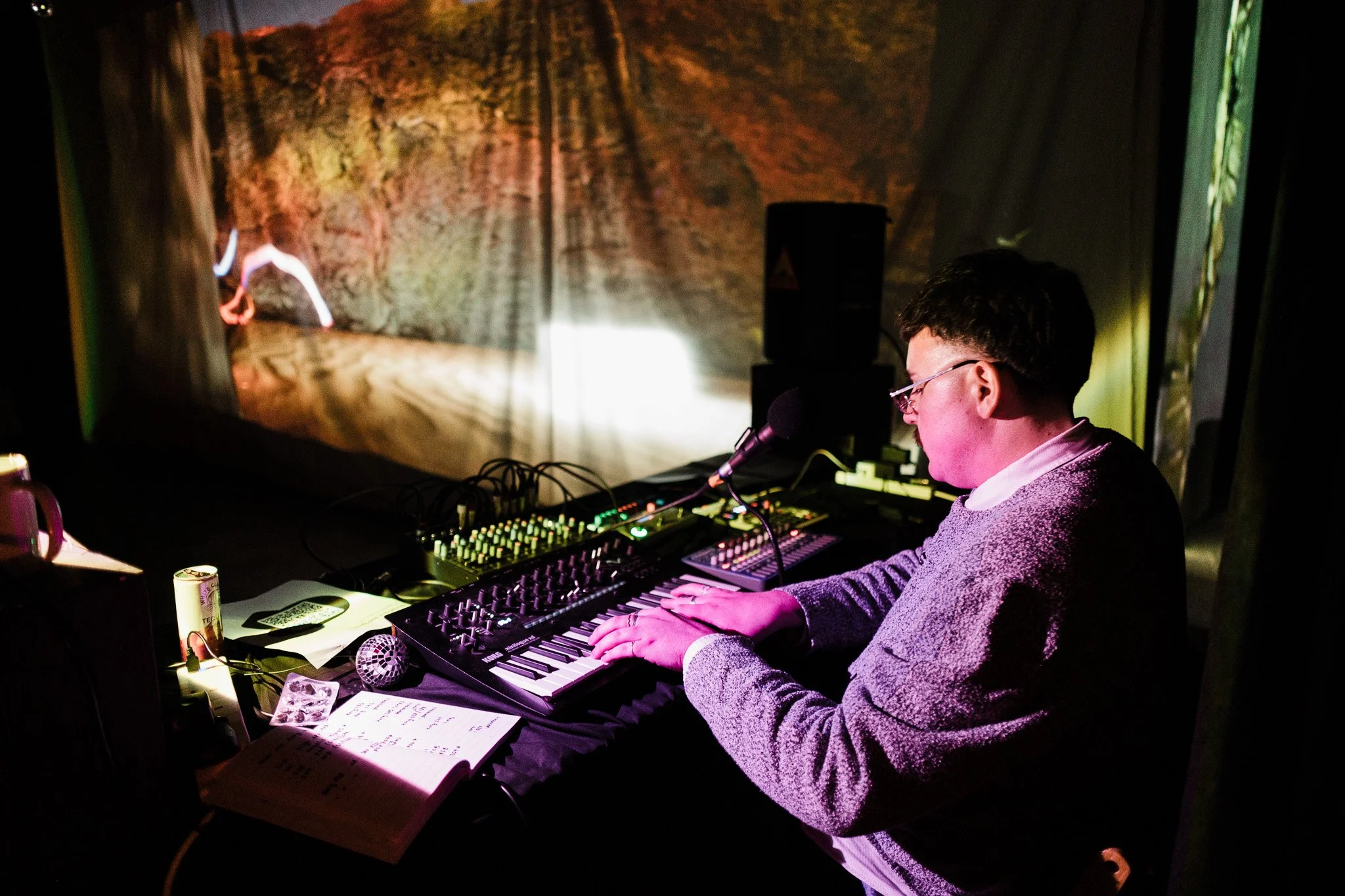
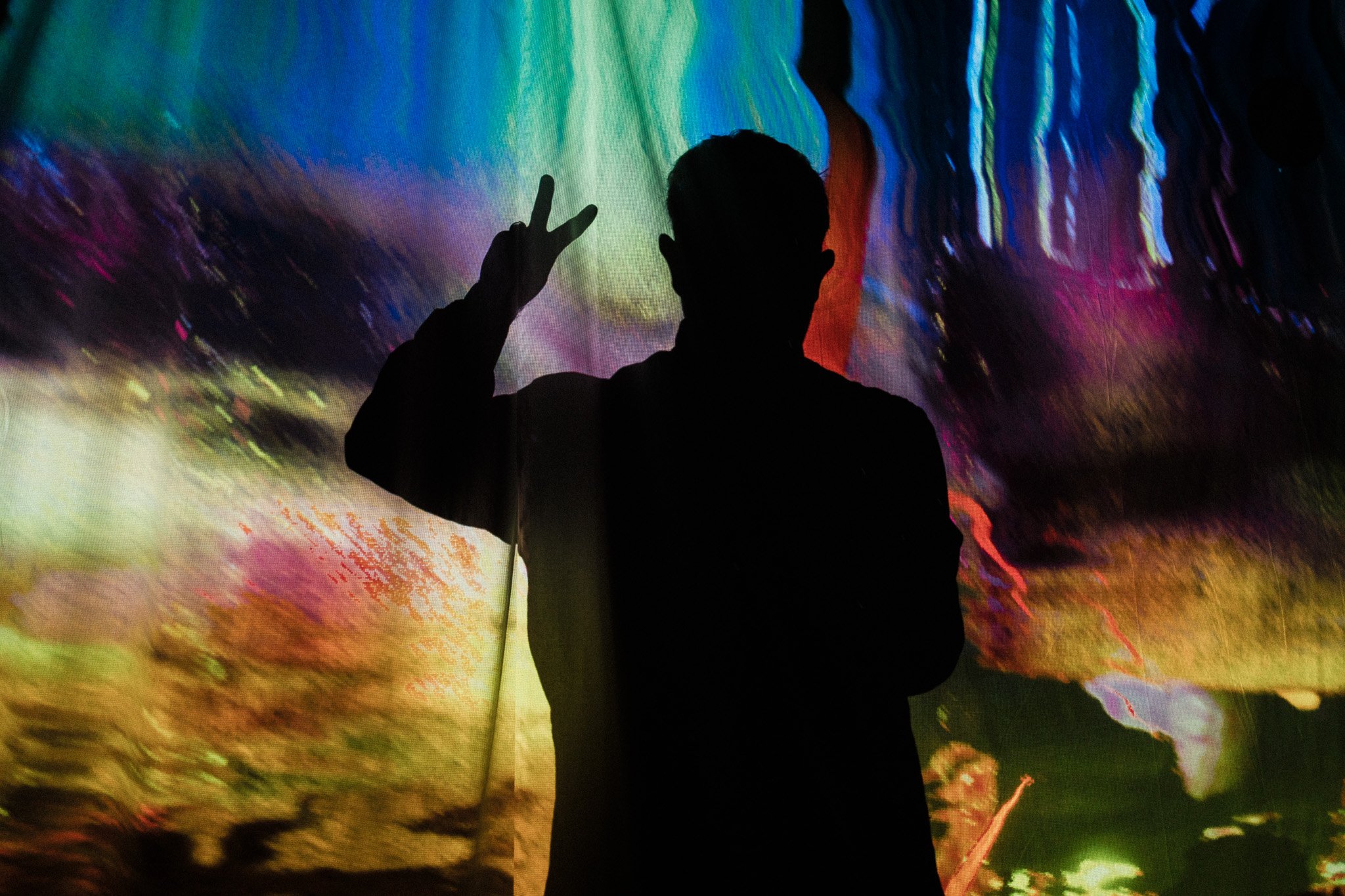
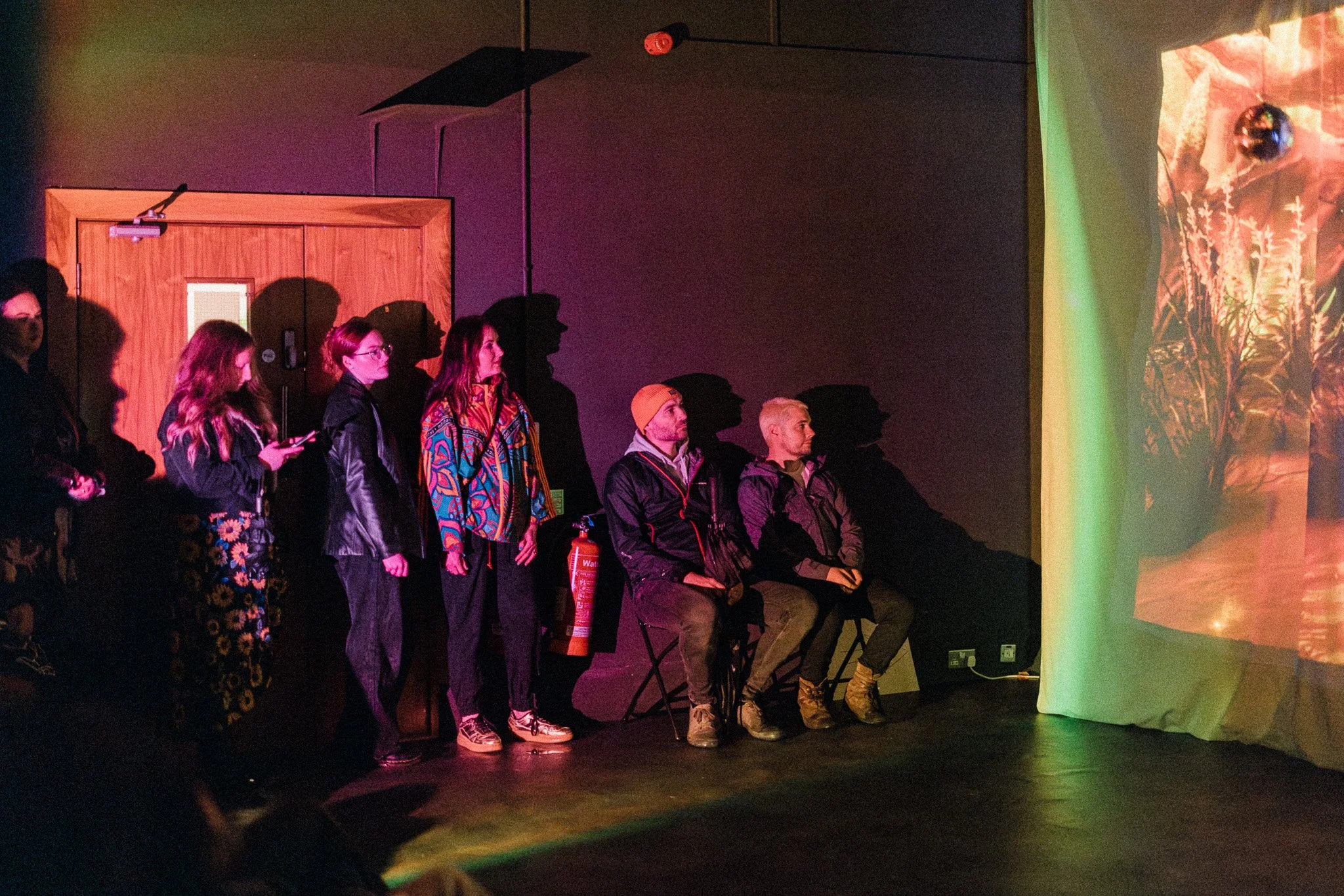
The piece occupies a dimly-lit ground floor space at Vault Artist Studios on an autumn evening, rain battering windows behind drawn black curtains. The room is dominated by a large suspended fabric, draped ceiling to floor and almost bisecting the gallery (there is a small gap to the left, an invitation to step behind the arras to a more contemplative zone). A sofa on the right with a single game controller beckons you into this comforting space. Also on the right, a projector beams a saturated, shimmering world onto the rippling fabric while opposite, seated at a table on which various pieces of electronic music equipment and a mic are arranged, is J SHIELDS, setting the scene with a gentle ambient drone.
Sitting down and taking up the controller, I recall the pairs’ introductory text for the show in which they promised ‘an ambient audio-visual space’ and ‘an opportunity for restful restoration amongst the hectic flux of the city centre’ (not least the hectic flux of Late Night Art itself, Belfast’s increasingly popular monthly gallery showcase). Outside the traffic rumbles, the occasional passing bus causing the building, constructed on reclaimed land, to gently shudder and at one point, a police sirens howls – yet I do not feel any inclination to turn my head to investigate. Promise fulfilled.
One navigates the digital landscape as if playing a first-person shooter: a control to move in any given direction, another to look around, and a button for jumping should you feel the need. Your on-screen avatar mirrors your actions, in this case a multicoloured elongated shape propelling forward like a gulper eel or will-o'-the-wisp. At certain points throughout the evening, I see people spinning the avatar around just for the pleasure of seeing its tail oscillate like a gymnast’s ribbon.
The point of view is low – one feels close to the ground, about eye level to a blade of grass, clambering over rocks or into bodies of water. Movement is steady and smooth, and of course more sluggish when moving underwater. In this world, time of day is hard to pinpoint – sometimes there are blue skies, sometimes it is dusk, other times still there are stars (or is this the reflected light from mirror balls suspended from the ceiling?). The interstitial environment itself is hard to categorise – one area feels sylvan but without trees, a grove or thicket of fungi/seaweed/coral-like formations towering overhead; another feels riparian, with plants growing near the edge of a freshwater pool; yet another feels coastal with clumps of marram grass giving way to rippling sands and rock formations jutting out of the sea. These plant forms have the ability to feel simultaneously familiar and alien, analogue and digital. The fronds of one such formation feel fungal, the texture shiny and firm (one imagines), its surface speckled peach and pink like an inflamed throat. There are underwater rocks with similar patterns that feel like tiger cowrie shells. Down here, everything shimmers, accentuated by the rippling fabric, and all is beautifully lit. A cluster of bioluminescent plant formations feels otherworldly, magical even, generating their own eerie light. I think again about the exhibition text which promises to explore botanical life as a mirror of our own existence, reflecting the shared biological language spoken by human bodies and nature. Indeed, everything feels alive, pulsating, and sentient somehow – some affinity is genuinely felt with these non-human lifeforms.
On the opening night, James undertook what was, in effect, a durational performance. For three unbroken hours, his music slowly shifted from drones to shimmering arpeggios, over which ethereal vocals floated. Not a big fan of synth pre-sets, Shields prefers to ‘synthesise everything from scratch’, utilising field recordings of speech snippets (sometimes WhatsApp voice notes from his friend Jess), birdsong, or even samples of his own songs, including vocals, which get chopped up until they become unrecognisable, layered and subsumed into a sonic texture. This current approach in ‘Static Bloom’ is very much to do with where J SHIELDS is at the moment in terms of ambient music – in contrast to work he did in the past which he says utilised more traditional verse-chorus song modes. Nowadays, he enjoys using his voice as another texture over sustained, swelling drones of layered sine waves and slow moving LFOs with activated samples of ‘plucks and sparkly sounds’. Some of these sounds are literal plucks – samples of his sister’s harp playing used like little bookending moments throughout the performance, responding in real time to users’ interactions with the piece. He admits to being ‘obsessed with different ways that you can use your voice as an instrument in itself – rather than something that complements instruments’. Stacking hall reverbs and echo and tape delays and playing with vowels sounds, overtone singing, and different styles of vibrato, the effect is almost operatic at times as Shields employs his full four-octave range.
The session as a whole combined the creation of a general atmosphere but also, as mentioned, responding to events in real time where possible. For example, in the placement of words in strategic spots around the fictive landscape, the white glowing all-caps ‘Hello’, ‘Welcome back’, ‘Wabi-sabi’, ‘Petrichor, and ‘Just in time’ corresponding to the voice note audio samples. These were triggered as users approached the words in the environment (mischievously so at one point as a person left the room: a distinct ‘bye now!’ was activated). But having said all that, the music both complemented the visuals as a sonic soundscape but also stood as a performance in its own right.
The world Dragos has created has a very different feel to that which featured in ‘Longitude of Longing’, which, although featured trees, vegetation and water, was primarily focused on architecture and the built environment. ‘After a long time exploring structural things and, with that, darker themes, I felt I wanted to focus on celebrating life and its beauty – the small things that get overseen if you’re stuck in your head too long!’, the artist responds. He goes on: ‘it’s definitely something new – and a bit nerve-wracking… but also exciting, to look at the both the beauty and fragility of vegetation and flora and spot the similarities between this layer of life and the fragility of our own human experience’. James adds: ‘We are both people who use electronic equipment to make some sort of natural motif, which I think is interesting... humans craving a bit of nature – and I use nature metaphors a lot for speaking about my own experience, like an evergreen that weathers winters – but using our very artificial tools to make something natural’.
In this, Shields hits on one of the many contrasts bound together in the work e.g., the creation of a calming space in the midst of a busy urban environment; the human voice paired with electronically manipulated sounds; digital projection on natural fabric; in short, using electronic means to create something that appears organic.
And the collaboration does not end here. Notwithstanding the hurdles of funding applications – and balancing art, paid work and life admin, not least an imminent studio move – Dragos and James plan to work together again future. It will be fascinating to see where this collaboration leads next.
Jonathan Brennan (Nov ’25)
[1] ‘An eye stimulated alone makes the ear impatient; an ear stimulated alone makes the eye impatient.’ Source: Bresson, Robert. Notes sur la cinématographe. (1975).